Blog
The onset of late autumn encourages us to look hard at the things in the gardens that are really earning their keep. Plants flowering or adding to the garden scene now tend to be extremely healthy and need very little care through the year. Here are some of the best plants in the gardens at Easton now.

Cotinus coggygria ‘Grace’ with Rubus thibetanus ‘Silver Fern’ in the Velvet Border. ‘Grace’ is an exceptional smokebush cultivar for autumn colour.

Colchicums in the Cedar Meadow. Although they are coming to the end of their flowering time and the slugs have had a little taste, these have been up for at least 3 weeks. This meadow is managed as a spring meadow and is mown from July onwards. When the temperature starts to drop, we stop mowing to prevent the heads of these lovely autumn bulbs from being decapitated.

Perhaps not to everyone’s taste is Prunus laurocastus ‘Marbled White’ but to my mind, beautifully marked. For us, this is the perfect shrub, being totally hardy, disease free, offering something all year round, easy to grow and not attractive to our resident rabbit population. It is growing quite densely but I am hoping to remove the lower branches as it grows. This will allow light underneath and we can plant delicate woodland plants below.

Rudbeckia triloba or Brown Eyed Susan. Technically a biennial this has flowered with us as a shortlived perennial. In flower for at least a month and totally unaffected by the frosts of the last couple of nights. This is still flowering in the long border with Aster turbellinus, see below.
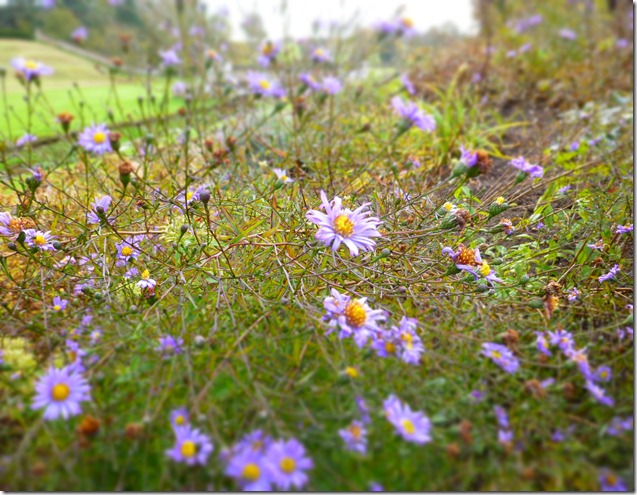
The last of our Asters to flower with a wiry but graceful habit, this perennial makes about 1 metre in our beds. The tiny buds and airy foliage have been attractive for months but it’s lovely to see the flowers now.
If you would like to see these plants and great autumn colour, the gardens are open on Sundays in November for FREE!
Well, O.k. Mostly it is… but its even better if you can do something everyone enjoys. We have been working hard scrubbing, mowing, polishing and devising to make sure you have a great visit to the gardens this week. Lots of our team at Easton have small children and we have spent time making sure your visit will be fun for everyone.
So… the children get to make grass hedgehogs, plant hyacinths to take home, play on the swing, play in the den and make collages out of autumn leaves. Together, you can explore the gardens enjoying the Autumn colour, plant a bulb in the meadows for posterity, roll pumpkins together and Christmas shop while the children colour in! Round off your visit to the tearoom and sample hedgehog cupcakes (which may have more chocolate than hedgehog in them).
A few things to do on your visit:
Roll a pumpkin, press gang small children into bringing them back.
 Swing under the Cedar tree and discover a den.
 Make a bald hedgehog, take him home and water him and watch the grass grow on his back
 Feed our snails and pot up a hyacinth to take home.
 Plant a bulb for posterity in the meadow near our giraffes
 Borrow our footballs, play games and run around A LOT…
 …go home tired and happy. zzzz.
The gardens are open Wednesday, Thursday, Friday and Sunday October 24-26th and 28th
For more information please click here
…go home tired and happy. zzzz.
The gardens are open Wednesday, Thursday, Friday and Sunday October 24-26th and 28th
For more information please click here
In September, Steve, Tim and I went to Whichford Pottery on a daytrip, following an irrestible invitation from Harriet Rycroft, the (as in, the only) Whichford gardener. She manages to transform 450 pots a year. Here’s one I particularly liked.
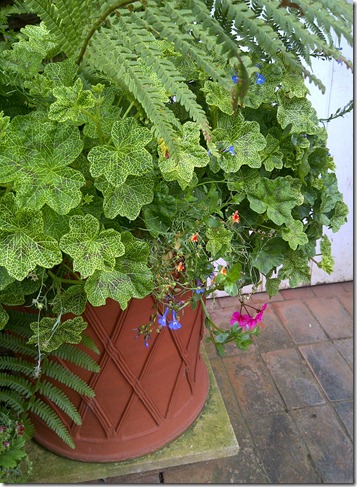 Whichford is a serious artisan pottery that is keeping old skills alive and developing new ones to adapt to new clays and customer requests. If this was a restaurant it would be world famous. As it is, the Japanese value the care and effort taken with each pot and they have kept the business as robust as it is through a difficult economic climate.
Harriet showed us how to plant a pot for colour from now until June. Our pots are not..ahem.. the stuff of Chelsea Gold so I was keen to see how she could get that much value out of one planting. Sure enough, with evergreens and a tonne of bulbs she made the whole thing look elegant and easy.
Whichford is a serious artisan pottery that is keeping old skills alive and developing new ones to adapt to new clays and customer requests. If this was a restaurant it would be world famous. As it is, the Japanese value the care and effort taken with each pot and they have kept the business as robust as it is through a difficult economic climate.
Harriet showed us how to plant a pot for colour from now until June. Our pots are not..ahem.. the stuff of Chelsea Gold so I was keen to see how she could get that much value out of one planting. Sure enough, with evergreens and a tonne of bulbs she made the whole thing look elegant and easy.
 The conifer is set just below the pot edge. Harriet is planting tulip bulbs good and deep and then adding a layer of compost,some slow release fertiliser, another layer of bulbs and so on until the bedding and evergreen plants are added to sit level with the conifer. Lastly, the smallest bulbs are just pushed into the pot.
Inspired by her scheme, this is our recipe mix for Winter and Spring pots. The conifer is set just below the pot edge. Harriet is planting tulip bulbs good and deep and then adding a layer of compost,some slow release fertiliser, another layer of bulbs and so on until the bedding and evergreen plants are added to sit level with the conifer. Lastly, the smallest bulbs are just pushed into the pot.
Inspired by her scheme, this is our recipe mix for Winter and Spring pots.
  You will need:
1.Pots, compost and slow release fertiliser. If using a large pot, place it in position first as it will get heavier as you plant.
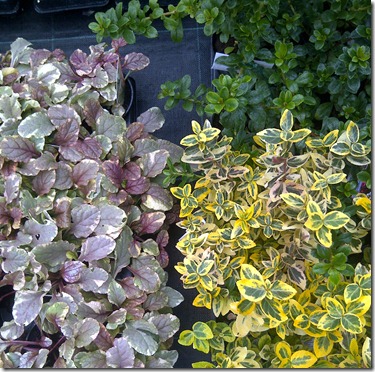
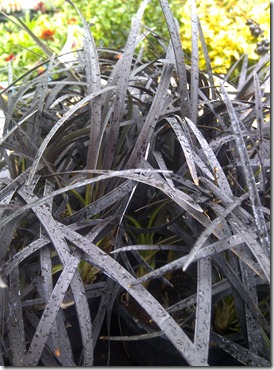
2. A selection of small evergreen shrubs and groundcover. This image shows (clockwise from top) Escallonia, Variegated golden Euonymus and Ajuga ‘Golden Beauty’ alongside the black grass Ophiopogon nigrescens.
3. Lots of bulbs for flowering from end of January to the end of May. For some pots I have gone for a strong statement of Tulipa ‘Blueberry Ripple’ and ‘Couleur Cardinale.’ As I built up the layers Fritillary meleagris, Iris Harmony, small Narcissi and Crocuses were added to the mix. Alliums can also be added for a last burst of colour.When we plant up the shrubs shown above, there will definitely be snowdrops involved.
4. Violas or Polyanthus to provide winter and spring colour. We have chosen Viola ‘Outback Fire’
You will need:
1.Pots, compost and slow release fertiliser. If using a large pot, place it in position first as it will get heavier as you plant.
2. A selection of small evergreen shrubs and groundcover. This image shows (clockwise from top) Escallonia, Variegated golden Euonymus and Ajuga ‘Golden Beauty’ alongside the black grass Ophiopogon nigrescens.
3. Lots of bulbs for flowering from end of January to the end of May. For some pots I have gone for a strong statement of Tulipa ‘Blueberry Ripple’ and ‘Couleur Cardinale.’ As I built up the layers Fritillary meleagris, Iris Harmony, small Narcissi and Crocuses were added to the mix. Alliums can also be added for a last burst of colour.When we plant up the shrubs shown above, there will definitely be snowdrops involved.
4. Violas or Polyanthus to provide winter and spring colour. We have chosen Viola ‘Outback Fire’
  Lurking in this pot until spring, with other bulbs, is Iris bucharica which will add fullness to the planting.
Finally I put a wire mesh over the top of the most precious pots, just in case the squirrels find the bulbs.
If you want to do something similar the collections in our online shop offer a beautiful mix of named bulbs for planting into pots now. Click here for details. Lurking in this pot until spring, with other bulbs, is Iris bucharica which will add fullness to the planting.
Finally I put a wire mesh over the top of the most precious pots, just in case the squirrels find the bulbs.
If you want to do something similar the collections in our online shop offer a beautiful mix of named bulbs for planting into pots now. Click here for details.
Once a year I feel ashamed of the garden and it is always in August. There comes a week when nothing goes right. The garden has ‘Gone August’. 100 years ago, when the family spent a full month in the big house, no wonder the gardeners relied on bedding. The hedgerows and trees take on a tired look and the delicate blue and pink perennials and shrubs go over, sometimes not very attractively. The colours of autumn arrive – dirty pinks and strong orange and yellow. They will glow in the September light but the flat harshness of an August day does not show them at their best.
  Grubby colours in harsh light. Yeuch! Scroll down for some more uplifting images! Grubby colours in harsh light. Yeuch! Scroll down for some more uplifting images!
The weather knows all this. So, we get drought, torrential downpours and richocheting temperatures to add to our troubles. Both of our mowers, challenged by incessant mowing of wet grass early in the year are getting more and more temperamental and the continued strong growth of hedges and grasses in the meadows means the job list is stretched. On top of this, we have lots of visitors who deserve a friendly stress-free welcome and many of the team take a well-earned break this month. ‘You shouldn’t give holidays in August’ people tell me to my moaning but I think they work incredibly hard all year and many have family commitments and basically, they need the break.
This feeling used to last the month when we first started out but now we have a better structure and some student labour to help out so I have cut it down to about one week. I am very aware that, although we see the gardens all the time and carry memories in our head of spring and summer, a few of our visitors will only give us one chance to persuade them that this is a garden worth telling their friends about (and we need that, for sure.) So last week, when the feeling started to creep in that we were not on top of the extra work, I pulled in help from wherever I could get it.
This Sunday, the Meet the Artist day as part of the textile exhibition was a great event and although I chuntered about the odd weed (cheeky ragwort in the meadows mostly) I felt we could head on into Autumn confidently.
Next year, I hope my July diary entry will read: ‘Dont forget the gardens will ‘Go August’. GET PLANNING. No-one wants to hear you fretting, thank you!’ (Best Mary Poppins' voice)
On the upside here are some Good Things about August:
 The Long Border (but see a few weeds sneaking onto the gravel)
 Agapanthus flourish between the greenhouses and seed themselves here, adding to their number year on year.
 The greenhouse goes bonkers with lush growth and produce.
 Late Annuals in the Pickery start to take over from cornflowers and calendulas.
The beautiful wildflowers left in the meadows are swamped by insects: Scabious, Wild Marjoram and Knapweed in particular. Butterfly colonies are good. The swallows are clustering overhead ready to make the most of the insect feast as it rises from the grasses and trees.

There comes a point in the gardening year when we go from grow, grow, grow, plant, plant, plant to chop, chop, chop, prune, prune, prune. That point is now and we are starting to shear the hedges, prune the trained fruit and the BIG one, cut the meadows. Here we are in action:
Before: plant, plant, plant:
  After: prune, prune, prune
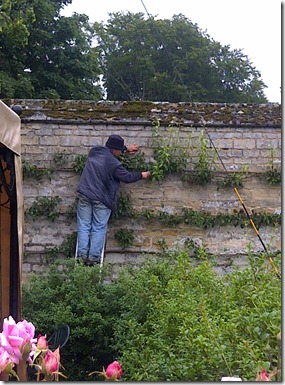  Cut, cut, cut:
  Being young is no excuse not to help…
 We really are making hay while the sun shines. Come and see us in action before the next round of Great British weather.We are open four days a week.
A new flower has appeared on the snowdrop bank without any of us planting it…the suspicion has fallen on an unknown visitor secretly adding to the gardens.

|
|
|
|
|


